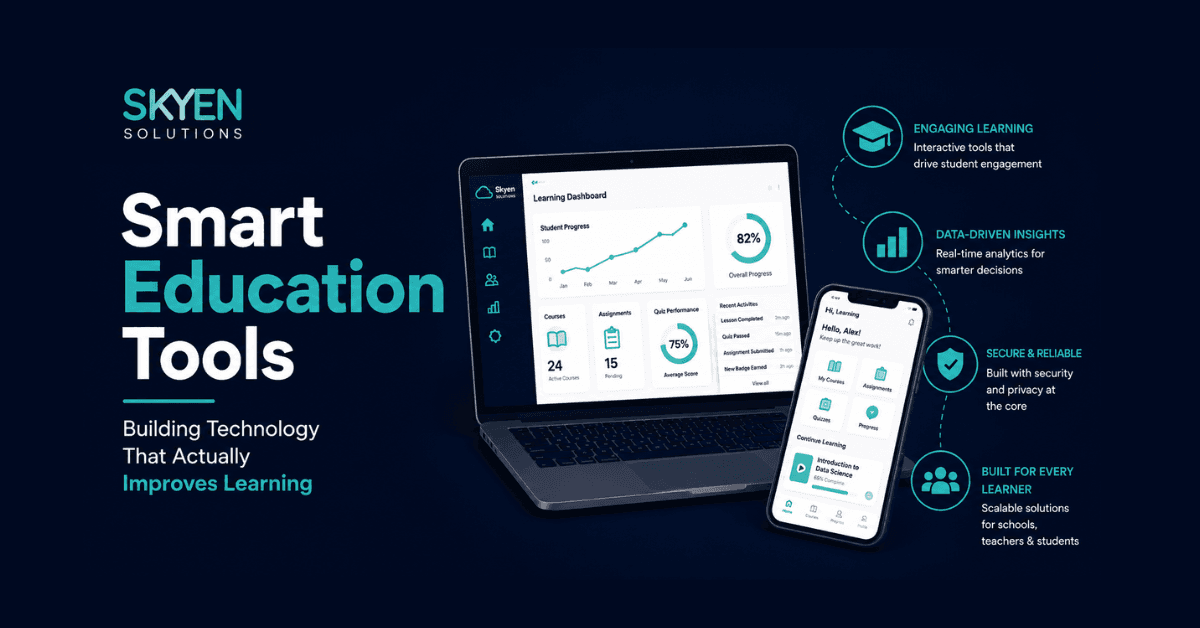
Smart education tools are digital systems that use data, automation, or adaptive logic to personalise learning and reduce manual work for teachers. They go beyond static digital content by responding to how each student actually performs in real time.
Schools have no shortage of digital tools, but many still operate as static replacements for paper — a worksheet online is still just a worksheet. Smart education tools are different because they respond to student behaviour, adjusting content, flagging problems, and reducing the manual tracking work that eats into teachers' time. At Skyen Solutions, we design and build smart education tools for schools and education providers, and the projects that succeed are always grounded in a specific classroom problem, not a general push toward "more technology."
This guide covers what separates genuinely smart tools from digitised worksheets, the technical foundations that make them work, and how schools can evaluate whether a tool will actually deliver value.
What Makes an Education Tool "Smart"
The defining feature of smart education tools is responsiveness. Rather than presenting fixed content to every student, these tools adjust based on real performance data — difficulty level, pacing, or even the type of explanation offered, depending on where a student is struggling.
Digital education tools that lack this responsiveness still have value, but they function more as content delivery systems than intelligent learning aids. The distinction matters when schools are deciding where to invest limited budget.
Automation is the second defining trait. Learning support tools that automatically flag struggling students, generate progress reports, or surface curriculum gaps save teachers hours of manual analysis every week — time that can go directly back into instruction.
Categories of Smart Education Tools Schools Are Adopting
Adaptive assessment tools represent one of the fastest-growing categories. These systems adjust question difficulty in real time based on student responses, producing far more accurate insight into actual understanding than fixed-format tests.
Classroom technology tools focused on engagement — interactive whiteboards paired with responsive software, or real-time polling systems — help teachers gauge understanding during a lesson rather than discovering gaps days later during marking.
Administrative automation tools, while less visible to students, often deliver the highest time savings. Automated attendance tracking, grade calculation, and progress reporting free teachers from repetitive tasks that don't require professional judgment.
The Technical Architecture Behind Smart Education Tools
Smart tools rely on structured data collection as their foundation. Every interaction — a quiz answer, time spent on a task, a repeated mistake — needs to be captured and stored in a way that supports meaningful analysis later.
Machine learning components, where used, typically focus on pattern recognition rather than complex generative tasks. Identifying that a student consistently struggles with a specific type of problem, for example, is a well-suited and reliable use of predictive modelling in an education context.
Integration capability matters just as much as the core functionality. Smart education tools that connect cleanly with a school's existing learning management system or student information system avoid creating yet another disconnected data silo for staff to manage.
Avoiding the "Technology for Technology's Sake" Trap
Schools sometimes adopt smart tools because they sound innovative, without a clear plan for how teachers will actually use the insights generated. A tool that flags struggling students is only useful if there's a defined process for teachers to act on that information.
The most effective implementations start with a specific, named problem — students disengaging during independent work, or teachers spending too long marking formative assessments — rather than a general goal of "modernising" the classroom.
It's also worth being honest about adoption friction. Even excellent digital education tools fail if the interface is confusing or the setup process demands too much time from already-stretched teaching staff.
Measuring Whether a Smart Tool Is Actually Working
Usage data alone isn't enough to judge success — a tool can be used frequently without improving outcomes. Schools should track specific metrics tied to the original problem, such as time-to-mastery on a topic or reduction in students falling behind benchmark levels.
Teacher feedback deserves equal weight to student outcome data. If teachers find a tool cumbersome or find its insights unclear, adoption will decline over time regardless of the tool's theoretical effectiveness.
Regular review cycles help too. Smart education tools should be reassessed each term or semester, since curriculum changes or shifting student needs can affect whether a tool continues to add genuine value.
Working With a Development Partner on Smart Education Tools
Choose a partner who asks about specific classroom workflows before proposing a solution. Generic software development experience isn't enough — understanding how teachers actually plan lessons and assess students shapes better design decisions.
Data privacy needs particular attention, since smart tools collect detailed behavioural data on minors. Ask directly about encryption standards, access controls, and compliance with Australian education data privacy requirements.
At Skyen Solutions, we build classroom technology tools by starting with the teachers and students who'll actually use them, ensuring the final product solves a real problem rather than adding another system to manage.
Final Thoughts
Smart education tools deliver real value when they're built around specific classroom problems and designed for genuine day-to-day use by teachers and students. The schools getting the most from this technology are the ones treating it as a targeted solution, not a blanket upgrade.
Want to bring smarter, more responsive tools into your classrooms? Contact Skyen Solutions today for a free consultation, and let's identify exactly where smart education tools could make the biggest difference for your school.
Frequently Asked Questions
What's the difference between smart education tools and regular digital learning content?
Smart education tools respond to real student performance data in real time, while regular digital content simply digitises static materials without adapting to individual student needs.
Do smart education tools require a lot of teacher training?
Well-designed learning support tools should require minimal training. If a tool demands extensive setup or ongoing manual configuration, it's often a sign of poor interface design.
How is student data kept safe in smart classroom technology tools?
Reputable providers use encryption, role-based access controls, and compliance with Australian student data privacy standards to protect information collected through these tools.
Can smart education tools integrate with our existing school systems?
Yes, most modern digital education tools are built to integrate with existing learning management and student information systems, avoiding duplicate data entry.
How do schools measure the success of a smart education tool?
Success is best measured against specific outcomes tied to the original problem, such as improved time-to-mastery or reduced numbers of students falling behind benchmarks, alongside direct teacher feedback.